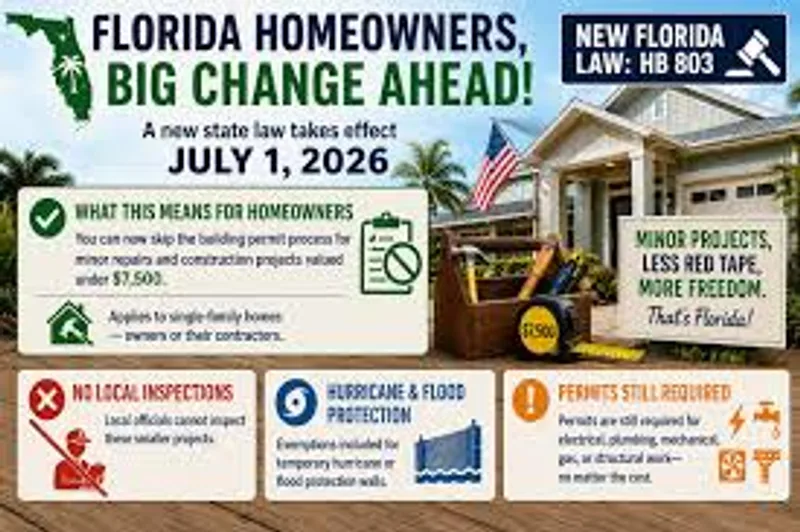
If you've seen the headlines, you'd think Florida just made fence permits optional. "No permit for work under $7,500!" sounds like a green light to skip the paperwork and start digging post holes this weekend. Florida House Bill 803 (CS/CS/HB 803) is real, it takes effect July 1, 2026, and it genuinely changes how building permits and inspections work across the state. But for fences in Broward and Palm Beach County, the reality is far more limited than the headlines suggest. At XL Fencing — licensed under Broward County #U-22428 and building fences across South Florida since 2015 — we read the bill so you don't have to. Here's what HB 803 actually does, and why most South Florida fences still need a permit.
What HB 803 actually changes
HB 803 requires local governments to exempt certain work on single-family residential property valued at $7,500 or less from building permit requirements. That's the part everyone is quoting. What gets left out of the headlines is the list of exclusions written into the same sentence.
The exemption does not apply to electrical, plumbing, structural, mechanical, or gas work — and it does not apply at all to property located in a flood hazard area. The bill also blocks contractors from splitting one large job into several sub-$7,500 pieces just to slip under the threshold, and it keeps a permit requirement in place for retaining walls that span more than one lot.
The law does several other things too: it sets new deadlines for how fast building departments must review permit applications, expands the role of private plan reviewers, and reduces certain commercial permit fees. Useful for builders — but the headline number, $7,500, is the part homeowners ask us about. So let's answer the real question.
So does your fence need a permit under HB 803?
In most of South Florida, yes — you should still expect to pull a permit for a new fence. Here's the honest reason: HB 803 never mentions fences. Not once. The exemption is written around small, non-trade home improvements, and it specifically carves out anything "structural." Whether your fence counts as structural is a decision your local building department makes — not the homeowner, and not the headline writer.
That distinction matters enormously here. Broward and Miami-Dade sit inside Florida's High-Velocity Hurricane Zone, where fences have to be engineered to resist specific wind loads under the Florida Building Code. A fence that has to survive a hurricane is, by almost any reading, structural — and structural work is exactly what HB 803 leaves out of the exemption. Add the flood-zone carve-out (more on that below), and the practical takeaway is simple: for the typical Broward or Palm Beach homeowner, a new fence is still a permitted job.
If you have a pool, you need a permit — full stop
There is one situation where the $7,500 question never even comes up: a pool barrier fence always requires a permit, regardless of cost.
Florida's pool safety rules treat the fence around a pool as a life-safety barrier, not a cosmetic improvement. The height, the gap at the bottom, the gate self-closing and self-latching hardware, and the spacing of the pickets are all dictated by code so a small child can't get through to the water. No $7,500 exemption overrides a life-safety requirement. If your project touches a pool enclosure in any way, plan on a permit and an inspection — and work with a contractor who builds to pool code every day.
Flood zones: the South Florida catch most homeowners miss
This is the provision that quietly cancels the exemption for a huge share of our service area. HB 803's permit break does not apply to property that is partially or entirely located in a flood hazard area, as defined by the Florida Building Code. Coastal and low-lying Broward and Palm Beach neighborhoods are heavily mapped into flood zones — which means the exemption many homeowners are counting on simply doesn't reach them.
The good news is you can verify your own flood status for free before you plan anything. The authoritative federal source is the FEMA Flood Map Service Center. Broward County residents can search their address on the county's interactive Flood Zone Map, and Palm Beach County residents can use the county's flood zone GIS lookup. If your property is in a flood zone, the HB 803 exemption is off the table — and you'll want a permit anyway to keep your insurance and resale paperwork clean.
The one change that actually helps homeowners: your HOA
Here's where HB 803 delivers a real, fence-relevant win. The bill amends Florida's homeowners' association law so that an HOA can no longer require you to obtain a building permit before the association will review your project. In the past, some boards created a chicken-and-egg loop: the city wanted HOA sign-off, the HOA wanted the permit first. HB 803 cuts that knot.
One important caveat — this does not abolish HOA approval. Your association can still enforce its own architectural standards on fence style, height, color, and materials. What it can no longer do is hold your permit hostage as a precondition for that review. If you live in a deed-restricted community, you still need the HOA's blessing on the design; you just won't get trapped in the old ordering problem.
Bottom line — check before you build
HB 803 is good news for Florida construction overall, and it genuinely streamlines small, non-structural projects in inland, non-flood-zone neighborhoods. But for South Florida fences — hurricane-rated, often near water, sometimes around a pool, almost always inside an HOA — the safe assumption is that you still need a permit. Skipping one to chase a headline exemption can cost you far more later in failed inspections, denied insurance claims, and problems at resale.
You don't have to figure out which box your project falls into alone. If you're unsure whether HB 803 applies to your fence — or whether your address sits in a flood zone — call XL Fencing at (954) 482-0531. We'll tell you straight, pull the permit if you need one, and build it to code the first time. Start with our South Florida fence permit guide, see whether your specific fence needs a permit, or review our full permit requirements overview.
Frequently asked questions
Does HB 803 mean I can build a fence without a permit if it costs less than $7,500? Not reliably in South Florida. The exemption excludes structural work and any property in a flood hazard area, and it never names fences. Because Broward and Palm Beach fences are typically hurricane-rated and often in flood zones, most still require a permit. Confirm with your local building department before you build.
When does HB 803 take effect? July 1, 2026. The permit exemption and the other changes — review deadlines, expanded private providers, and the HOA provision — all begin on that date.
Do I still need a permit for a pool fence under the new law? Yes. A pool barrier is a life-safety requirement under Florida code and is not eligible for the $7,500 exemption, regardless of the project's cost. Pool enclosure fences always require a permit and inspection.
Can my HOA still make me get approval for a fence? Yes. HB 803 only stops your HOA from requiring a building permit as a prerequisite for its review. Your association can still enforce its architectural rules on fence height, style, color, and materials, so you still need its approval on the design.
This article is general information, not legal advice. Permit requirements vary by jurisdiction and by property. Always confirm your specific obligations with your local building department or call XL Fencing for guidance before starting any fence project.