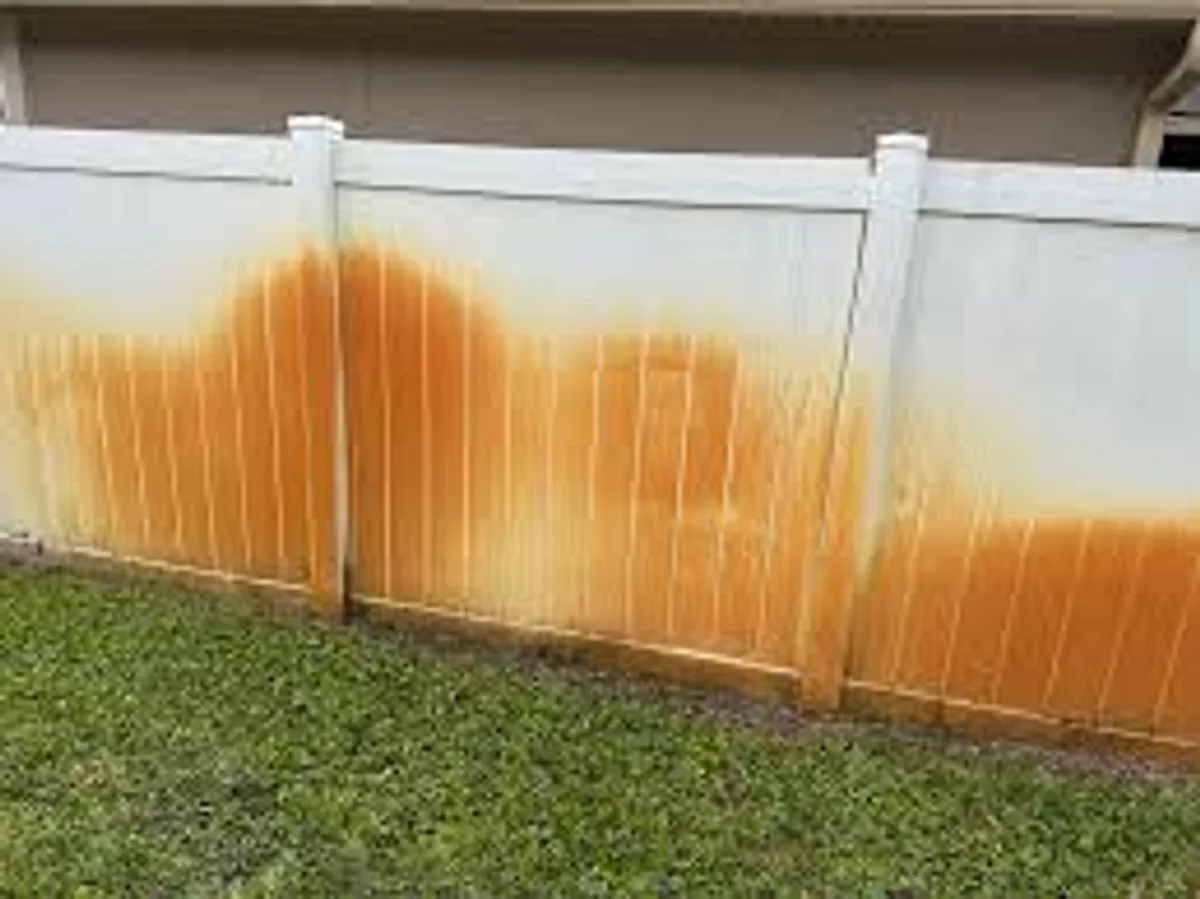
You wash your white vinyl fence, it looks brand new… and a few weeks later the bottom is streaked orange-brown again. Before you blame the fence or the installer, look at your sprinklers. In South Florida, the most common cause of a rust-stained fence isn't a defect — it's the water coming out of your own irrigation system.
If your sprinklers run on well water, this guide explains exactly why it stains, how to get the orange off, and how to stop it from coming back.
Why well water stains fences in South Florida
Most irrigation wells here pull from the shallow surficial aquifer, and that water is naturally high in dissolved iron. You can't see the iron while it's in the water — it's clear coming out of the head. But the moment that spray hits your fence and meets the air and sun, the iron oxidizes. Oxidized iron is rust, and it bonds to whatever it dried on: your fence, your stucco, your driveway, your pavers.
That's why the stain almost always shows up as a fan-shaped orange pattern at the bottom of the fence, lined up exactly with where a sprinkler head sweeps. It's the same reason so many South Florida homes have rusty streaks running down a white wall under a sprinkler.
What it stains (and what it doesn't)
Iron staining shows up worst on light surfaces, so a white vinyl (PVC) fence is the most obvious victim — the orange is impossible to miss against white. But it also stains:
- Aluminum fencing — especially white and lighter finishes
- Stucco walls, pavers, and concrete driveways
- Wood, though graying and weathering tend to hide it more
The important part: this is a water problem, not a fence problem. A new fence sprayed by the same well will stain just as fast. Fixing the water (or where it lands) is the only permanent answer.
How to know it's well water and not something else
A few quick tells:
- The stains are orange/rust colored (not green algae or black mildew) and concentrated at the bottom of the fence.
- They form a fan or arc that matches a sprinkler's spray path.
- They're worse on the sides of the yard the sprinklers reach and absent where the spray doesn't.
- If your irrigation runs on a well (not city/municipal water), you're almost certainly looking at iron.
How to stop it (this is the part that actually matters)
Cleaning the fence does nothing if the sprinklers keep painting it with iron every morning. Start here:
- Re-aim or swap the sprinkler heads. The cheapest fix is simply keeping well water off the fence. Adjust the heads so the spray throws away from the fence, lower the arc, or switch the heads nearest the fence to a shorter throw or a drip line. Often this alone solves it.
- Run a rust-inhibitor injector on your irrigation. Systems like Rid O' Rust and similar dosing units feed a small amount of rust-preventer into the irrigation line so the iron can't stain what it lands on. This is the go-to fix when you can't keep the water off the fence.
- Add an iron filter to the well/irrigation supply. A whole-system iron-removal filter takes the iron out before it ever reaches a head. It's the most thorough option (and helps your whole property), though it's the bigger investment.
- Use city water near the fence if you have it. If your home has a municipal water line, running the zones along the fence on city water instead of the well removes the iron entirely on those runs.
- Water in the early morning, briefly. Timing won't cure iron on its own, but minimizing how long iron-laden water sits and dries on the fence helps, and early watering is better for the lawn anyway.
How to remove the orange stains you already have
Regular soap and water won't touch rust — you need an iron/rust remover, not a general cleaner. On vinyl and aluminum:
- Rinse the fence first so the surface is wet.
- Apply a rust-specific remover — oxalic-acid-based products (Super Iron Out, CLR, F9 BARC and similar) are made for exactly this. Follow the label.
- Don't let it dry on the surface, and rinse thoroughly when you're done.
- Skip abrasive pads and harsh solvents. Don't use Goof Off on vinyl, don't scrub with anything that scratches, and never paint a vinyl fence — it voids the manufacturer warranty.
- Always test in an inconspicuous spot first.
For a full rundown of safe cleaners by material, see our vinyl & aluminum care guide. Aluminum fences clean up the same way — gentle remover, rinse well.
The bottom line
Orange streaks on a white fence in South Florida are almost always iron from a well-fed sprinkler — not a bad fence. Remove the existing stains with a rust remover, then fix the source: aim the water away, add a rust inhibitor or iron filter, or run those zones on city water. Do that and your fence stays white instead of going orange every few weeks.
Thinking about a new fence and worried about staining? That's worth a conversation up front — we can talk through material, color, and placement relative to your irrigation so it stays looking right. Get a free estimate or call (954) 482-0531.
Quick FAQ
Will rust stains damage my vinyl or aluminum fence?
No — iron staining is cosmetic. It sits on the surface and comes off with a rust remover. It won't weaken the fence, but it will keep coming back until you address the sprinkler water.
Why does only the bottom of my fence turn orange?
Because that's where the sprinkler spray reaches. The fan-shaped stain at the base lines up with the head's throw pattern.
Does timing my sprinklers differently fix it?
Not by itself. The iron is in the water no matter when you run it. You have to keep the water off the fence or treat/filter the iron out.
Is the staining covered under my fence warranty?
No. It's caused by your water, not a defect in the product, so it isn't a warranty issue — and painting vinyl to cover it actually voids the warranty. Treat the water instead.
Can I just pressure-wash it off?
Plain pressure washing usually won't remove set-in iron and can damage the surface. A rust-specific remover does the real work; a gentle rinse afterward finishes it.
This article is general maintenance guidance. Always follow the manufacturer's instructions for your fence and any cleaning product, and test in an inconspicuous area first.